The Conversation
12 Aug 2025, 20:08 GMT+10
Share article
Print article
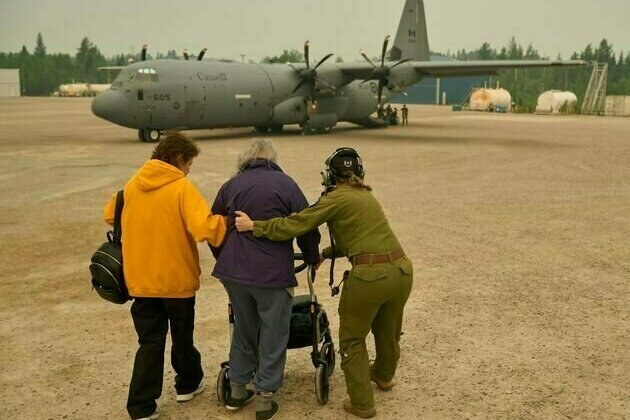
This summer, wildfires have caused evacuations across Canada and recently forced thousands of people to flee their homes in Newfoundland and Labrador.
Some of the biggest impacts are being felt in the Prairies. In Manitoba, authorities recently issued evacuation orders for 15,000 people, mostly in the province's north. Many evacuees are brought to larger cities like Winnipeg, overwhelming hotels and emergency housing.
In Canada, climate-driven migration is often imagined as a distant threat that affects others in the world. But these evacuations foreshadow a future where internal displacement becomes a regular feature of Canadian life - and where cities must rethink how they plan for disruption.
Events like the 88,000-person evacuation from Fort McMurray, Alta. in 2016 and the destruction of Lytton, B.C. in 2021 show how fast rural populations can be displaced.
Manitoba's evacuations are among largest in recent memory, and many evacuated communities are remote and poorly connected to infrastructure. For them, evacuation may soon become an annual reality.
At the University of Hong Kong's District Development Unit research lab (DDU), we develop architectural and urban strategies for rapidly urbanising regions in the Global South, where settlements are already experiencing the impacts of climate change. We've seen how post-disaster migration reshapes cities. These shifts are predictable in places where infrastructure and governance haven't kept pace with climate volatility.
Across Canada, services and infrastructure are already under stress. Housing is increasingly unaffordable, including in rural areas. Many rural regions, especially those with large Indigenous populations, struggle to access basic services.
Though these areas are home to 18 per cent of the population, they are served by only eight per cent of Canada's physicians. More than one quarter of rural school districts report closures or consolidations due to underfunding. These structural weaknesses form the backdrop to a slow-moving crisis - one that climate events are accelerating.
Elsewhere in the world, disasters regularly drive rural-to-urban migration and permanent urban change. In countries like Nepal and the Philippines - where our lab works - these movements are often rapid, informal and far beyond the scope of traditional planning.
In Kathmandu, the 2015 earthquake struck a city already marked by informal housing and fragile services. It accelerated a haphazard urban transformation characterized by uncontrolled sprawl, unsafe informal construction and overstretched infrastructure.
In the Philippines, typhoon recovery is often driven by necessity, with residents rebuilding informally. This results in growing slums and increasing vulnerability to future disasters.
These dynamics create new urban landscapes. In some cases, local governments are taking the lead, for example, by establishing local evacuation centres in the Philippines.
Elsewhere, informal encampments, home extensions and land occupations take hold. These are responses that reflect not only survival, but governance: provisional infrastructures are built through necessity, negotiation and collective care.
Canada is not exempt from these dynamics. When disaster strikes, evacuees often seek refuge in cities, where better public infrastructure offers some stability. As climate change fuels ever-larger wildfires, this trend will grow, with smaller urban centres absorbing more people fleeing climate-stressed regions.
Yet policy remains far behind. There is no national framework for climate-induced displacement. Canada's immigration and housing policies have no category for internal climate migration. Disaster response remains reactive, coordinated mainly by municipalities and provinces through short-term tools like 211 or temporary shelters.
Interjurisdictional planning is minimal. Municipal climate plans rarely anticipate population surges or extended pressure on housing. Displacement is still treated as an occasional event, not as an enduring part of Canadian urban life.
Canada must begin to learn from places already living this future.
In Taiwan, civic centres double as emergency shelters, equipped with backup power, water tanks and seismic isolation systems. In Japan, disaster-prevention parks embed solar lighting, cooking stations and toilets into public green spaces.
And in Mongolia, our lab has developed incremental urban strategies for Ulaanbaatar's ger districts - clustering growth, infrastructure and housing to adapt to rapid, uncertain settlement patterns.
These examples reflect a model of urbanism in which emergency response and long-term development are not separate, but part of a continuous, negotiated process.
Canada's geography, governance and urban forms demand their own set of protocols and prototypes. While lessons from elsewhere can guide us, they cannot be copied wholesale.
This means it is vital to develop a national framework for internal climate migration that integrates climate displacement into the National Housing Strategy.
All orders of governments should focus of developing multi-use resilience infrastructure, such as community centres and schools equipped for emergency response, and advancing adaptive housing policies that can expand or contract with demand.
Canada once helped shape global thinking on the transformation of urban areas. The 1976 United Nations Habitat Conference in Vancouver, catalyzed by the efforts of architects and planners, called for new models of settlement and development grounded in equity, participation and awareness of our planet's limits.
Nearly 50 years later, that unfinished legacy has a new urgency.
Today, climate displacement calls for a shift in how architects engage with the built environment - moving toward coordinated action with communities, policymakers and allied fields, and embracing models of practice that move beyond the traditional role of service provider - to actively initiate change.
Architects must engage not only with buildings, but with the frameworks that govern land, infrastructure and migration itself. This means challenging the professional neutrality that too often aligns design with extractive systems, and instead welcoming practices capable of working across institutions, jurisdictions and communities.
A national summit could mark the beginning of this shift by creating a forum to discuss climate migration and design the tools, policies and partnerships that will shape its outcomes.
The question is not whether climate movement will occur, but whether we will be prepared to meet it with intention, care and foresight.
Get a daily dose of Calgary Monitor news through our daily email, its complimentary and keeps you fully up to date with world and business news as well.
Publish news of your business, community or sports group, personnel appointments, major event and more by submitting a news release to Calgary Monitor.
More Information(Photo credit: Junfu Han / USA TODAY NETWORK via Imagn Images) Michigan coach Sherrone Moore might have the answer, but he's not...
Vienna [Austria] August 12 (ANI): Tom Cooper, a well-known Austrian military analyst and historian specialising in combat aviation...
(Photo credit: Brad Penner-Imagn Images) America will celebrate its 250th birthday with a UFC fight card at the White House, Dana...
Greenwood [US], August 12 (ANI): The Bochasanwasi Shri Akshar Purushottam Swaminarayan Sanstha (BAPS) on Tuesday condemned yet another...
Greenwood [US], August 12 (ANI): Bochasanwasi Shri Akshar Purushottam Swaminarayan Sanstha (BAPS) on Tuesday thanked US Congressman...
(Photo credit: Reid Glenn / USA TODAY NETWORK) The Toronto Sceptres announced a two-year contract with forward Emma Gentry on Tuesday....
CANBERRA, Australia: Prime Minister Anthony Albanese announced on August 11 that Australia will formally recognize a Palestinian state,...
(Photo credit: Reid Glenn / USA TODAY NETWORK) The Toronto Sceptres announced a two-year contract with forward Emma Gentry on Tuesday....
Canberra [Australia], August 12 (ANI): Australian Prime Minister Anthony Albanese said that Israeli Prime Minister Benjamin Netanyahu...
BRUSSELS, 12th August, 2025 (WAM) -- The European Union, the United Kingdom, and Japan, along with 21 other countries including Canada...
Share article Print article This summer, wildfires have caused evacuations across Canada and recently forced thousands of people...
(Photo credit: Kirby Lee-Imagn Images) The Los Angeles Dodgers head into Tuesday night's game with the Los Angeles Angels knowing...