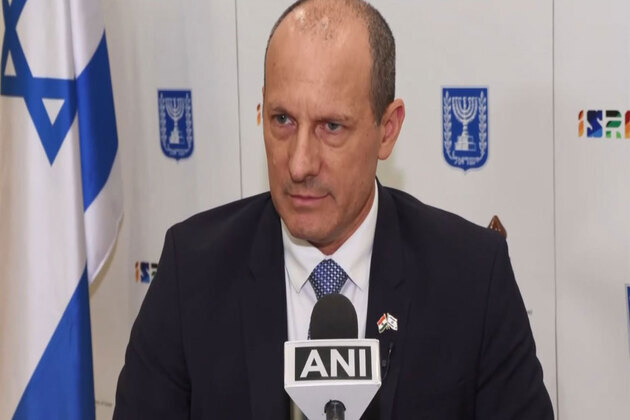
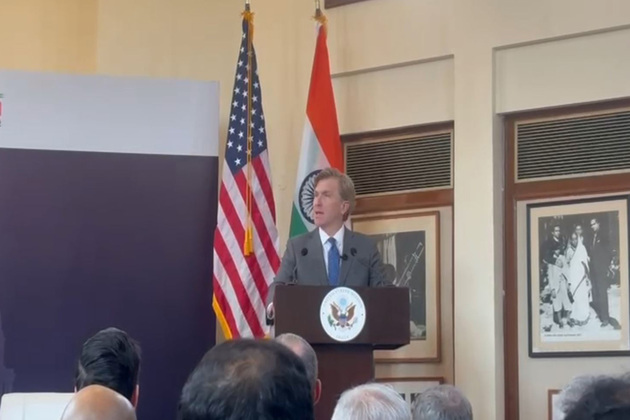
New Delhi [India], March 24 (ANI): Noting that the United States sees India not merely as a key partner, but as an essential one in ensuring favorable balance of power in Asia, US Under Secretary of War for Policy Elbridge Colby on Tuesday said his country's assessment of Indo-American partnership has its roots in practicality and is a manifestation of what the national security strategy calls Flexible Realism.
At a Special Session in New Delhi, Elbridge Colby said the US approach to the strategic partnership is interest-based and realistic, shaped by geopolitics and incentives as opposed to gauzy aspirations or detached idealism.
'The United States views India with deep respect as a republic of continental scale, as a nation with a proud strategic tradition, and as a country whose decisions will profoundly shape the future of the Indo-Pacific and the international landscape more broadly. Our two countries, of course, differ in history, geography, and perspective in important ways,' he said.
'Yet we share something fundamental, a conviction that the future of Asia should be determined by sovereign nations able to chart their own course. In that vein, today I would like to outline how the United States thinks about our relationship with India in the geopolitical and defence domains,' he added.
Colby said his goal is to lay out a logical, coherent framework that can help guide the defence cooperation 'between our two proud and independent countries amid tectonic strategic changes'.
Colby, who is in India to engage with senior officials, said the world is passing though one of the most significant shifts in global power in generations and noted that US and India's interests and long-term prosperity will be decisively shaped by developments in the Indo-Pacific region.
Although the visit is a pre-scheduled one, it assumes importance in the light of the West Asia crisis.
'We are living through one of the most significant shifts in global power in generations. The Indo-Pacific has become the central theatre of international politics, economics, and security. Indian, but also American interests and long-term prosperity will be decisively shaped by developments in this region. In addressing these trends, the United States recognises a basic reality. No single country can sustain a stable balance of power in Asia,' Colby said.
'The region is too large, too varied, and too important. Stability will instead depend on the collective contributions of capable states that share an interest in maintaining a free and open Indo-Pacific. Building on Secretary of War Pete Hegseth's important speeches at Shangri-La last spring and at the Reagan National Defence Forum last December, I laid out our thinking on what this entails at the Sejong Institute in Seoul this past January. Viewed from this vantage, India's role is indispensable. India's importance stems not only from its size and economic potential, but also from its geography and strategic position. Your country sits astride the Indian Ocean, which is the connective tissue of the Indo-Pacific,' he added.
The senior US official said India possesses a long tradition of strategic autonomy and a growing capacity to shape events well beyond its borders.
'It is the largest republic in the world. Its success thus carries profound symbolic and political weight and has formidable, self-reliant, and capable military forces willing and able to shoulder significant security responsibilities. The United States sees India not merely as a key partner, but as an essential one in ensuring a long-term, favorable balance of power in Asia,' he said.
'At the same time, we (India-US) approach our partnership with realism, clarity, and a fair dose of humility. Our assessment of the Indo-American partnership has its roots in practicality, what our president frequently calls common sense. In line with this, our approach to the strategic partnership is interest-based and realistic, shaped by geopolitics and incentives as opposed to gauzy aspirations or detached idealism,' he added.
Colby said the United States clearly recognises that India has its own interests, its own strategic culture, and its own priorities, and that India is not shy about advancing them.
'But that is what we want. As our national security strategy and national defence strategy make clear, the United States wants partnerships with vigorous, self-assured states, not with dependencies. We want key partners that, in resolutely advancing their own interests, will also have the effect of advancing our own. This is a manifestation of what the national security strategy calls Flexible Realism,' he said.
'By aligning our efforts with those states that are willing and able to advance their own, we thereby can contribute to attaining both of our goals. In that vein, our efforts to cooperate with India are designed not only to collaborate on key issues, but also to strengthen and enable your country precisely in order to promote and sustain a favourable regional balance of power that serves us both. Fortunately, our perspective and yours are, it seems, deeply aligned,' he added.
Colby said External Affairs Minister S Jaishankar, has termed India's approach Bharat First and its strategic approach the India Way.
'Like America First and Flexible Realism, Bharat First and the India Way emphasise the centrality of a realistic approach to foreign policy, an unabashed willingness to put one's own national priorities first, and a results-oriented mindset about international politics. Minister Jaishankar emphasised the importance of viewing and developing India's foreign policy from a hard-headed national perspective and stressed the greater need, the need for greater realism in policy. He contended that geopolitics and the balance of power are the underpinnings of international relations. He noted that India advanced in its interests effectively when it made hard-headed assessments of contemporary geopolitics and called for an unsentimental audit of Indian foreign policy,' he said.
The senior US official said that Jaishankar affirmed the enduring appeal of nationalism and assessed that a nationalistic foreign policy outlook is likely to approach the world with more confidence and greater realism.
'He announced that creating a stable balance in Asia is India's foremost priority. From our point of view, exceptionally well said. The approach that Minister Jaishankar has laid out resonates deeply with our own on many levels, but most importantly at that of fundamental perspective. Both of us (India, US) believe that countries must operate with confidence in defending and advancing their own interests, and that that is not only prudent, but also right,' Colby said.
'Both of us believe that foreign policy grounded in concrete national interests creates a stronger and more self-sustaining foundation for cooperation and indeed for peace. Both of us believe that a durable and stable balance of power in Asia is a topmost priority. As a result, when the United States acts to secure the safety, prosperity, and freedom of the American people, and India acts with equal determination on behalf of the Indian people, our efforts will frequently and materially reinforce one another. At the same time, we do not expect nor do we require unerring agreement. Rather, we are flexible, looking for areas of agreement where they count most,' he noted.
Colby said the United States recognises that foreign policy should be practical and about results.
'As Minister Jaishankar wisely advised, the circumstances of today require flexible arrangements that are customised to the challenge. In the same vein, it is actually a key strength of the US-India relationship that it rests not on dusty formalities and unchallengeable shibboleths, but on a hard-headed, clear-eyed recognition of overlapping interests. Accordingly, as President Trump said to Prime Minister Modi during his visit to Washington, India and the United States have a special relationship. This then appears to be the broad agreed conceptual framework,' he said.
'Within it, I would highlight several key pillars framed in the spirit of Minister Jaishankar's admonition that the key is to develop and sharpen strategic clarity. First, the United States and India do not need to agree on everything to cooperate effectively. What matters most is that our interests and objectives increasingly converge on the most fundamental issues. Differences and even disputes are fully compatible with deepening alignment and cooperation on strategic matters,' he added.
The senior US official said that roots of partnership between India and US are deeper than optics and more durable than superficial comity.
'Rather, they are thickly embedded in lasting strategic mutual self-interest. Both of our countries benefit from an Indo-Pacific in which no power can dominate the region. Both benefit from open trade and national autonomy. These are the concrete shared interests that form the foundation of our enduring strategic partnership...'. (ANI)



 Share
Share
 Tweet
Tweet
 Share
Share
 Flip
Flip
 Email
Email