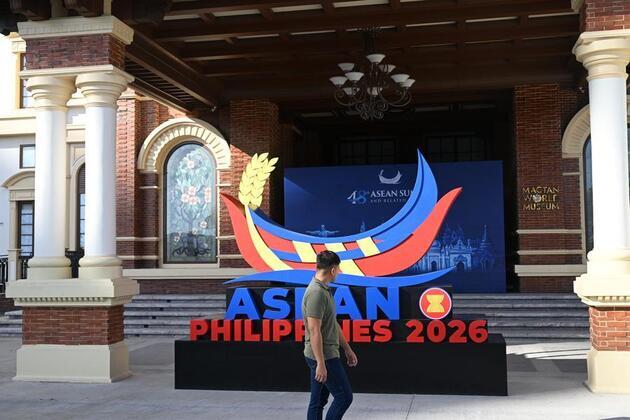
Xinhua
20 May 2026, 16:15 GMT+10
For ASEAN, drawing closer to China represents a pragmatic response to where growth, stability and opportunity increasingly reside.
by Julia Roknifard
As the global economic center of gravity shifts steadily eastward, Southeast Asia finds itself in an era where pragmatism, connectivity and development take precedence over ideological confrontation.
For the 10 Association of Southeast Asian Nations (ASEAN) member states, the overriding priorities remain industrialization, resilient supply chains and rising living standards for nearly 700 million people. In this context, partnership with China appears not merely convenient, but structurally logical.
China today is a key growth engine in an increasingly non-Western-centric world economy. Through proposals such as the Belt and Road Initiative (BRI) and the Global Development Initiative (GDI), it offers what many developing regions value most: large-scale financing, rapid project execution and a stated doctrine of non-interference. Railways in Laos, ports in Malaysia, industrial parks in Indonesia and other projects are tangible manifestations of a development model focused on physical transformation rather than political conditionality.
For ASEAN countries, many of which continue to grapple with infrastructure deficits, these are not abstract geopolitical considerations but concrete development priorities. Road and rail connectivity, power grids and manufacturing capacity translate directly into jobs, urbanization and greater social mobility. China's own experience in lifting hundreds of millions out of poverty lends credibility to its development path and provides a model for others in the region.
At the same time, Southeast Asia's perception of the West has grown increasingly cautious. ASEAN policymakers prize predictability above all else. Supply-chain security, stable market access and freedom from sudden policy shocks are essential to long-term planning. Washington's recent trade posture, characterized by reciprocal tariffs, export controls and pressure for strategic alignment, is widely viewed as disruptive and destabilizing.
As U.S. domestic political divisions increasingly spill over into its international trade and foreign relations, many regional observers see the United States as an unpredictable actor whose policy direction can shift sharply, undermining the stable external environment ASEAN economies seek to preserve. Recent developments in the Middle East have further reinforced such concerns.
Many in the region interpret these developments as a form of coercive economic statecraft, where access to the U.S. market may come with conditions that limit policy autonomy or constrain ties with other partners. Even long-standing allies have found themselves targeted by tariffs or pressured into renegotiating trade arrangements. Partnership with the United States is therefore often perceived as conditional, with those conditions subject to abrupt change.
China's approach emphasizes continuity and scale. Its demand for commodities, intermediate goods and consumer products provides a stabilizing anchor for regional growth. Chinese tourists, students and investors constitute important economic lifelines for several ASEAN economies. Crucially, Beijing has emphasized China's development as based on mutually beneficial and win-win cooperation rather than hegemonic ambition.
While ASEAN has long emphasized neutrality and non-alignment, the gravitational pull of China's economy, combined with growing uncertainty surrounding Western policies, is gradually bringing rebalance in the region.
Security considerations further reinforce this trend. While open military conflict in Asia remains unlikely, economic competition is already intensifying. Technology restrictions, sanctions regimes and supply-chain decoupling have transformed commerce into a theater of strategic rivalry. For smaller and middle powers, stability remains the overriding concern. Regime change, proxy conflicts and political upheaval are seen as existential threats to development gains painstakingly achieved over decades.
There is also a growing perception that Western discourse on human rights and democracy has become inconsistent, even instrumentalized. While ASEAN societies place high value on dignity and welfare, they often prioritize collective stability over confrontational politics. The spectacle of polarization, social unrest and declining public trust in some Western countries undermines the moral authority that once accompanied their economic leadership.
China, for its part, promotes development as the foremost human right and a pathway out of poverty, hunger and insecurity. Whether one fully accepts this stance or not, it resonates strongly across much of the Global South, where material improvement remains a key benchmark of effective governance.
Ultimately, ASEAN's trajectory will be shaped less by ideology than by practical outcomes. If partnership with China continues to deliver tangible benefits while preserving political autonomy, the region's cooperation with China is likely to deepen organically. If the West hopes to remain influential, it will need to offer greater consistency, mutual respect and long-term commitment rather than episodic engagement and coercive leverage.
The emerging world is increasingly pluralistic. Within this rapidly changing landscape, China stands as a pillar of inclusive global development focused on connectivity, production and development. For ASEAN, drawing closer to China therefore represents a pragmatic response to where growth, stability and opportunity increasingly reside.
Editor's note: Julia Roknifard is a senior lecturer at the School of Law and Governance at Taylor's University in Malaysia.
The views expressed in this article are those of the author and do not necessarily reflect those of Xinhua News Agency.
Get a daily dose of Calgary Monitor news through our daily email, its complimentary and keeps you fully up to date with world and business news as well.
Publish news of your business, community or sports group, personnel appointments, major event and more by submitting a news release to Calgary Monitor.
More InformationFor ASEAN, drawing closer to China represents a pragmatic response to where growth, stability and opportunity increasingly reside....
Over two days, US President Donald Trump has repeatedly raised the prospect that the cease-fire with Iran will be broken by new US...
(260520) -- MEXICO CITY, May 20, 2026 (Xinhua) -- Photo taken on May 19, 2026 shows the FIFA 2026 World Cup commemorative coins in...
New Delhi [India], May 20 (ANI): All India Majlis-e-Ittehadul Muslimeen (AIMIM) chief Asaduddin Owaisi launched a fierce attack on...
San Francisco [US], May 20 (ANI): Major technology companies in the United States are continuing workforce restructuring amid the growing...
New posts 07:49 Bill Cassidy, one of the four Republican senators who backed the resolution last night aiming to increase congressional...
TOKYO, Japan: Honda Motor reported its first annual loss since listing on the stock market in 1957 after taking more than US$9 billion...
(Photo credit: Mark J. Rebilas-Imagn Images) Behind 31 points from Brittney Sykes and 30 from Marina Mabrey, the expansion Toronto...
(Photo credit: Wendell Cruz-Imagn Images) Ben Rice hit a tiebreaking two-run homer with one out in the fifth inning off Dylan Cease...
(Photo credit: Kiyoshi Mio-Imagn Images) The Colorado Avalanche expected to be in this position when they started training camp in...
(Photo credit: Charles LeClaire-Imagn Images) New Jersey Devils coach Sheldon Keefe will remain behind the bench, according to multiple...
(260519) -- TORONTO, May 19, 2026 (Xinhua) -- People shop for groceries at a farmers' market in Toronto, Canada, May 19, 2026. Canada's...